


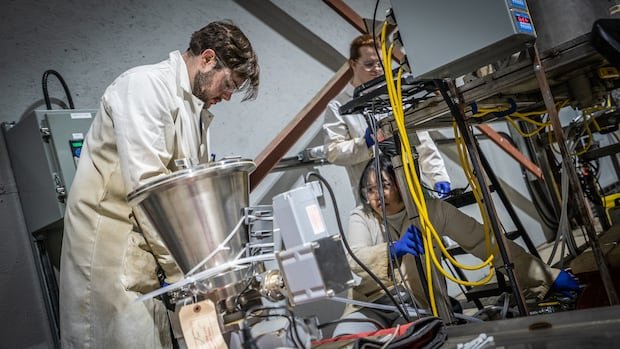

Researchers in Sudbury, Ontario are currently engaged in efforts to expand the application of bacteria-powered technology to extract valuable metals from old mine waste on a larger scale. MIRARCO Mining Innovation is conducting trials at a pilot facility to assess how microbes can break down mine tailings, which are the residual rock and sediment from mining activities, and liberate essential minerals such as nickel, cobalt, and copper through a process known as bioleaching.
Even though bioleaching technology is widely adopted in international mining, with around 30 mine sites globally utilizing this method, Canada has yet to fully implement it commercially, as noted by Nadia Mykytczuk, the CEO of MIRARCO, the research division of Laurentian University. Mykytczuk, along with other experts, spoke to CBC during a recent tour of the 10,000-square-foot pilot facility in Sudbury to showcase the workings of bioleaching technology.
Despite the significant value of the waste material, companies have been hesitant to invest in reprocessing the tailings due to the high costs associated with returning the material to the smelter. Consequently, the usual practice is to mix tailings with water and store them in large ponds, leading to concerns about long-term environmental risks.
Jaime Kneen, the national program co-lead at MiningWatch Canada, highlighted two main risks associated with this practice: the chemical behavior of the material and its long-term stability. There is a concern that tailings could produce acid and release metals gradually, potentially contaminating the surrounding environment. To mitigate these risks, tailings are often stored underwater, but this method poses a different risk of dam failure over time, as exemplified by the Mount Polley mine tailing dam collapse in 2014 in British Columbia.
Given the global demand for critical minerals for clean energy technologies and national defense, both the federal and provincial governments have been advocating for increased critical mineral development. Mykytczuk emphasized that bioleaching not only addresses the demand for critical minerals but also contributes to mining site remediation. The technology offers a significant opportunity to extract billions of dollars worth of critical minerals quickly from mine waste.
While similar bioleaching projects are underway across Canada, many are still in the early stages. The federal Critical Minerals Research, Development, and Demonstration program is supporting several projects, including the Sudbury initiative, to advance such technologies towards commercial utilization.
Bioleaching involves grinding down tailings and mixing them with a liquid solution to nourish bacteria. As the bacteria metabolize the minerals, chemical reactions occur, allowing the metals to separate and transfer into the liquid. The resultant slurry progresses through a series of reactors for further processing, ultimately extracting the metals in liquid form. Researchers are striving to replicate this process on a larger scale in a continuous flow system, rather than batch processing, to optimize efficiency.
After bioleaching, some waste material remains, but it is devoid of toxic elements and can be repurposed for various applications, such as construction or as backfill in mining operations underground. The growth of specialized bacteria to target specific minerals found in mine waste is a crucial aspect of the bioleaching process, requiring precise analysis and strategic extraction methods.
Moving forward, the research team aims to convert the extracted metals into commercially viable products, showcasing their value to industrial partners. The next phase involves transitioning from pilot testing to full-scale operations within Canada in the coming years, marking a significant milestone in advancing bioleaching technology on a commercial scale.