


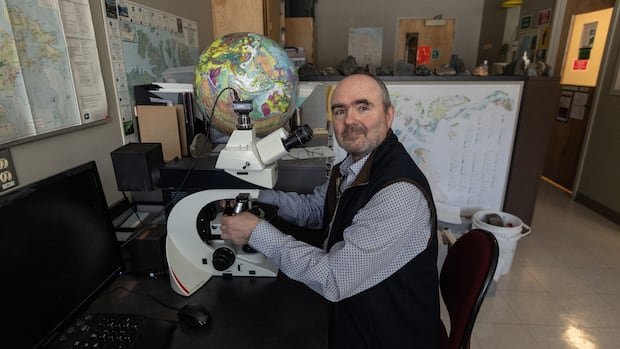

Renowned diamond explorer and scholar Graham Pearson, known for his work in various locations from the coalfields of northern England to the Arctic and the jungles of Brazil, has been honored with a mineral named after him. The International Mineralogical Association recently approved the naming of a newly discovered mineral, Grahampearsonite, found inside a deep-Earth diamond in Brazil.
Pearson, a mantle geochemist at the University of Alberta in Edmonton, has dedicated decades to studying mantle geology and mineralogy, establishing himself as a leading authority on diamonds and their insights into the Earth’s interior. His research in Brazil, conducted over a decade ago, contributed significantly to understanding the composition and water content of the Earth’s deep mantle through discoveries made with deep-mine diamonds.
Expressing humility and gratitude, Pearson remarked on the significance of having a mineral named after him, emphasizing the lasting impact of scientific data produced by researchers. Grahampearsonite was unearthed within a diamond that formed at depths exceeding 300 kilometers beneath the Earth’s surface in Brazil’s Juina region. The mineral, with a chemical composition of calcium, phosphorus, and oxygen, was previously known as a synthetic material and is commonly used in products like toothpaste abrasive.
Researchers, utilizing X-ray techniques, examined the diamond containing Grahampearsonite, revealing its unique crystal structure. The mineral, resembling a prism, was officially named after Pearson in December to acknowledge his exceptional contributions to diamond research. Pearson, a pioneer in diamond research, has not only delved into the history of the Earth’s mantle but has also developed innovative methods for geochemical analysis and geological sample dating.
Born in the UK and raised in a mining town, Pearson’s interest in diamonds was sparked by his PhD advisor’s research on a rare graphite mineral that originated from a diamond. Moving to Canada in 2010, Pearson established the Arctic Resources Geochemistry Laboratory at the University of Alberta, where he continues to investigate minerals and diamonds in the Arctic region.
Highlighting the significance of ongoing mineral discoveries, Pearson emphasized the importance of natural occurrences over synthetic materials in scientific exploration. He noted that diamonds possess unique capabilities in retaining deep-earth elements and providing insights into plate tectonic cycles. With advancements in microscopy technology, Pearson anticipates the discovery of Earth’s remaining minerals, estimating that around 4,000 minerals are yet to be uncovered out of the approximately 4,800 known minerals.