


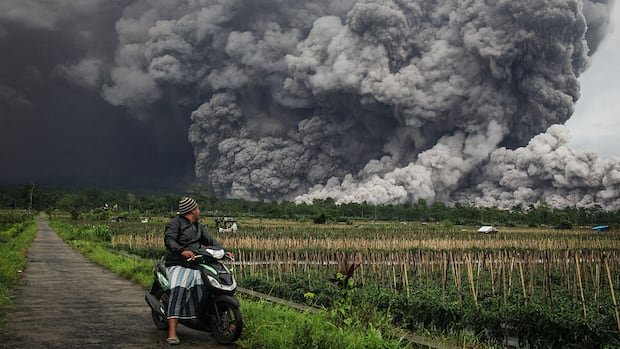

Indonesia’s highest peak on Java island, Mount Semeru, erupted on Wednesday, causing ash to cover several villages and leading to evacuations as authorities raised the alert level. The volcano in East Java province released hot ash, rocks, lava, and gas, with searing clouds traveling down its slopes up to seven kilometers multiple times, while a two-kilometer column of hot clouds rose into the air, according to Indonesia’s Geology Agency.
Throughout the day, the eruptions prompted authorities to increase the volcano’s alert level from the third-highest to the highest. Fortunately, no casualties have been reported. Over 300 residents in three at-risk villages in Lumajang district were evacuated to government shelters, stated Abdul Muhari, a spokesperson for the National Disaster Mitigation Agency.
Increased volcanic activity in the afternoon led to the expansion of the danger zone to eight kilometers from the crater, warning people to steer clear of the Besuk Kobokan River, the path of the lava flow. Social media videos captured ash clouds sweeping through a forested valley to a river below a bridge, causing residents to seek refuge in temporary shelters or move to safer areas.
Reports indicate that about 178 individuals, including climbers, porters, guides, and tourism officials, are stranded at the Ranu Kumbolo monitoring post on the 3,676-meter mountain. They were deemed safe at the post, located on the northern slope, away from the hot cloud flow moving southeast. Bad weather and rain forced them to spend the night there, according to Endrip Wahyutama, a spokesperson for the Bromo-Tengger-Semeru National Park.
Mount Semeru, also known as Mahameru, has a history of eruptions over the past two centuries. The last major eruption occurred in December 2021, resulting in casualties and evacuations. Indonesia, with over 280 million people, is situated along the Pacific “Ring of Fire,” prone to seismic and volcanic activities.