


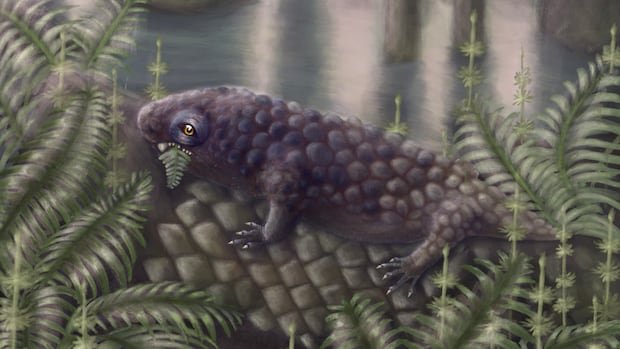

A recently discovered creature, similar in size to a football and capable of chewing tough plant material, may be one of the earliest plant-eating vertebrates ever identified. Known as Tyrannoroter heberti, this animal lived approximately 307 million years ago in a lush swamp on Cape Breton Island, Nova Scotia. During that period, most four-legged animals mainly consumed other animals due to a lack of the ability to process vegetation.
Scientists, in a recent study, revealed that Tyrannoroter heberti possessed the dental features suitable for a plant-based diet, challenging previous notions of the transition to herbivory. This finding sheds light on the rapid evolution of dietary adaptations in early vertebrates.
Belonging to a group known as microsaurs, Tyrannoroter was a small reptilian precursor to modern reptiles and mammals. Its skull, along with other fossil remains, was entangled within the roots of a massive ancient tree stump on the cliffs of Cape Breton Island. Award-winning amateur paleontologist Brian Hebert discovered the stump, leading to the naming of the species in his honor.
Research indicates that Tyrannoroter’s unique teeth structure, resembling “Hershey-kiss” shapes with multiple rows, enabled it to consume plant matter efficiently. This adaptation allowed for the grinding of tough plant material, marking a crucial step in the evolution of herbivory among early tetrapods.
The discovery of Tyrannoroter suggests an earlier onset of herbivory in vertebrates than previously thought. The presence of similar teeth structures in related species dating back to 318 million years implies a long history of plant-eating adaptations among these animals.
The study’s implications extend to the understanding of evolution, highlighting the significant impact of herbivores on ecosystems. Further investigations into the dietary habits and adaptations of early tetrapods like Tyrannoroter are crucial for unraveling the complexities of ancient ecosystems and the interplay between animals and plants.